
Stage 04

Expand

Make promising ideas visible, tangible and discussable.

Build prototypes at the right level of fidelity so people can see, experience and challenge the idea. Make concepts tangible enough to spark meaningful feedback while remaining flexible enough to evolve. Use prototypes to uncover assumptions, reveal opportunities for improvement, test user reactions and explore alternatives before committing significant time, effort or resources to full-scale development and implementation.

Expand: prototype and build

Investigate promising solutions through prototypes

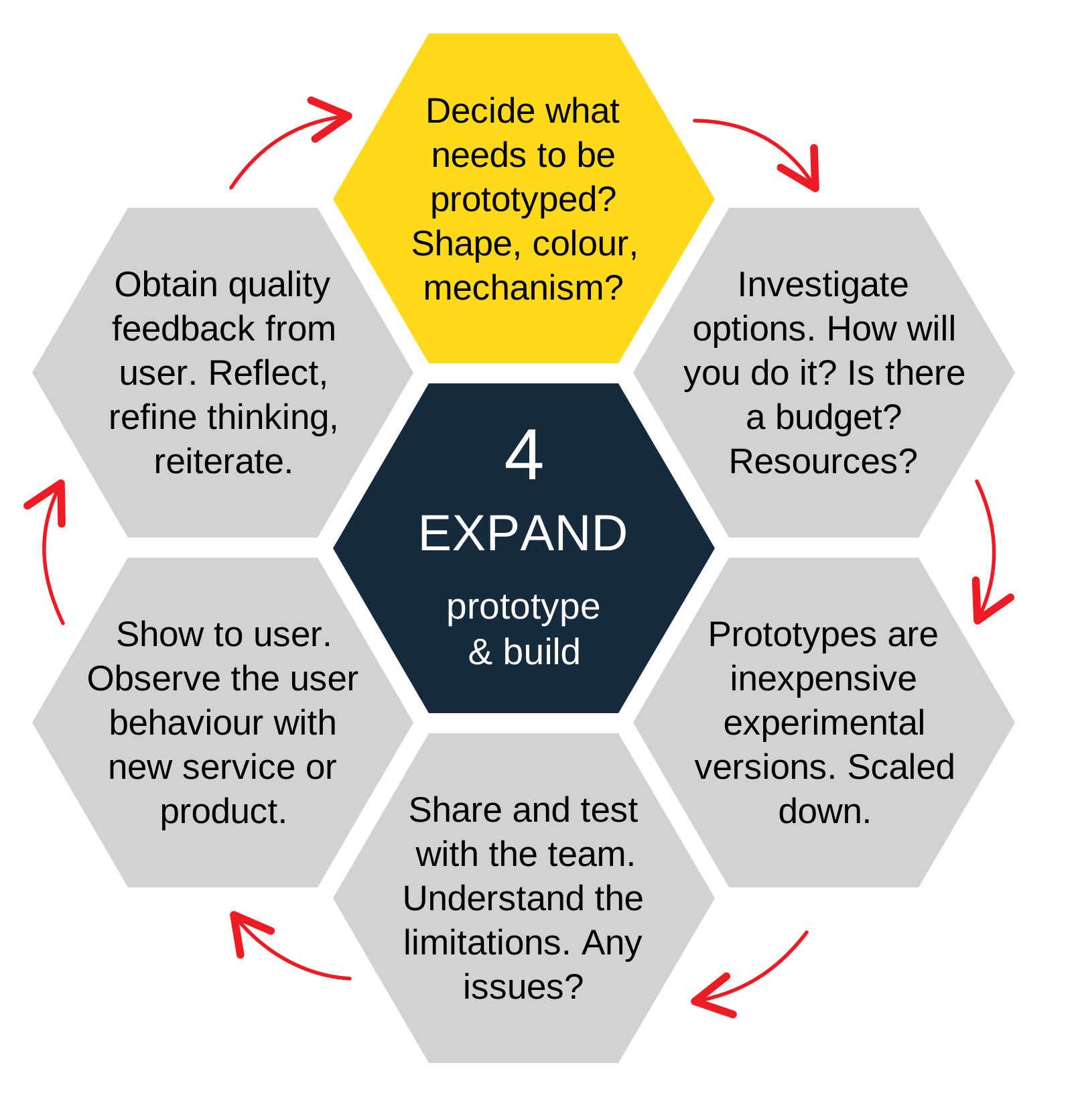
Step four of the 5E Design Thinking Framework is called EXPAND. This is an experimental stage. Its aim is to investigate the strongest possibilities developed during the first three stages. Ideas are implemented within prototypes and, one by one, accepted, improved or rejected according to what the team learns from users’ experiences.

The design team produces a number of inexpensive, scaled-down versions of the product, service or particular features to investigate key solutions generated during Explore. These prototypes can be shared and tested within the team, across other departments or with a small group of people outside the design team. By the end of Expand, the team has a clearer understanding of the proposition’s limitations and of how real users may behave, think and feel when they interact with it.

Use iteration to improve the design

The prototype step is iterative. The initial prototype is rarely the final version of a product or service. Testing may reveal areas for improvement or uncover new user needs. Designers use this feedback to modify the prototype and create a new version, repeating the process until the design meets user needs and fulfils the requirements of the project.

Prototyping is also collaborative. Designers work with team members, stakeholders and end users to create and test prototypes. Feedback from these groups helps identify aspects that require improvement or modification and provides evidence that can make the design more effective.

Transform ideas into something tangible

The prototype step is a critical phase of design thinking because it transforms ideas and concepts into tangible products, services or experiences that can be tested and refined. A prototype is a preliminary version that allows the team to visualise an idea, evaluate how it performs and refine it through feedback before committing to full-scale development.

Prototypes can be produced from paper, cardboard, clay, role-play, 3D printing, software and many other materials or methods depending on what is being developed and what the team needs to learn. Once the most promising ideas have been selected during Explore, prototyping makes those ideas visible and testable.

Core activities

Choosing an appropriate prototype

01

Low-fidelity prototypes

Low-fidelity prototypes are commonly made with paper, cardboard or other inexpensive materials. They are simple and quick to create, yet effective for testing basic concepts and iterating ideas during the early stages of development.

02

High-fidelity prototypes

High-fidelity prototypes are more detailed and realistic. They may use 3D printing, computer-aided design or advanced software. Although they take more time and resources to create, they can represent the intended product or service more accurately and help test specific features or functions.

03

Fidelity with purpose

Choose the simplest prototype capable of producing the evidence you need. Increase realism only when greater detail will support more precise feedback, observable behaviour or a better-informed decision.

Prototype, learn and repeat

Use tangible experiments to expose assumptions early.

By involving others in prototyping, designers can increase the likelihood that the final product or service responds to the needs of its intended audience. The process also reveals potential problems and challenges while change is still relatively easy and inexpensive.

Testing a prototype is not a request for approval. It is an opportunity to observe behaviour, gather feedback and learn what should be accepted, improved, combined or rejected. Each iteration should reduce uncertainty and strengthen the next version.

Methods to consider

Sketches, paper prototypes, role-play, storyboards, service walkthroughs and interactive models.

Evidence and output

Testable prototypes and explicit assumptions about desirability, feasibility and viability.

Why it matters

What prototyping makes possible

Early learning

Discover weaknesses, unanswered questions and new user needs before committing significant time, effort or resources to full-scale development.

Shared visibility

Transform abstract concepts into something users, stakeholders and team members can experience, discuss and challenge together.

Lower risk

Investigate the most uncertain aspects of an idea with an appropriately simple prototype and use evidence to guide investment decisions.

Collaborative refinement

Bring designers, colleagues, stakeholders and end users into the process so their feedback can improve the proposition across repeated iterations.

Methods and tools

Expand and Prototype

Prototype

Experiment

Experience

Feedback

Improve

Browse all resources →

Loading your thinking tools…

Across the website

Find your next idea.