
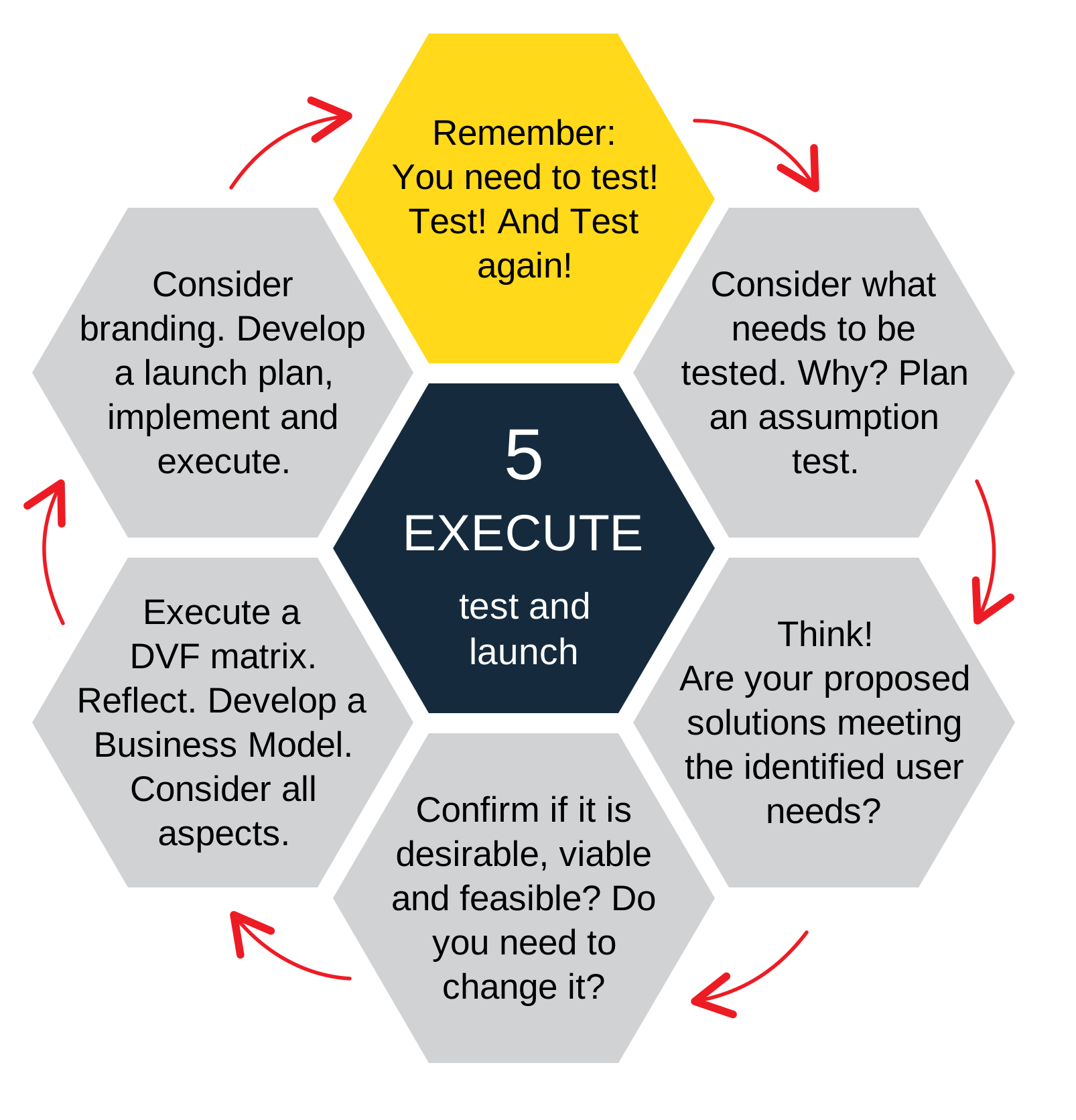
Stage 05

Execute

Test to learn – not merely to confirm.

Put concepts in front of users. Gather evidence, reflect, refine, and prepare a thoughtful path to implementation. Embrace experimentation as an ongoing learning process, using real-world feedback to validate assumptions, uncover opportunities, and reduce uncertainty. Measure outcomes against intended goals, iterate with purpose, and make informed decisions that strengthen the solution’s value, feasibility, desirability, and long-term impact.

Execute: test and launch

Test the complete proposition with real users

During Execute, designers and evaluators rigorously test the developed product, service or system using the strongest solutions identified through the earlier stages. This is the final named stage of the 5E Design Thinking Framework, but it is not necessarily the end of the problem-solving process.

Testing allows the team to investigate real conditions of use and develop a deeper understanding of how people think, behave and feel in relation to the proposition. It reveals which features work, which assumptions remain unsupported and what improvements are needed before implementation or launch.

Treat testing as learning, not confirmation

Testing is the phase in which designers evaluate their proposed solutions and gather feedback from users and stakeholders to determine whether the design meets the needs of its intended audience. Hypotheses and assumptions are validated through prototypes, user testing and iteration rather than through internal opinion.

Designers observe how people interact with the proposition, identify points of confusion or frustration and ask what participants value, dislike or would improve. Evidence from both behaviour and direct feedback provides a stronger basis for decisions than seeking approval for a predetermined answer.

Iterate, refine and revisit when necessary

Results are analysed for recurring patterns and common issues. Designers use these findings to improve the proposition, then test it again to determine whether the changes have strengthened the experience. This cycle may be repeated several times until the design meets user needs and project requirements.

Design thinking is not a linear process. Increased understanding during Execute may redefine the problem, reveal new questions or require the team to return to Engage, Evaluate, Explore or Expand. Further iterations and refinements help rule out unsuitable alternatives and deepen understanding of both the proposition and its users.

Core activities

Steps involved in the testing phase

01

Create prototypes

Prepare a prototype that is appropriate for the questions being tested. It may be a physical model, wireframe or digital mock-up and should remain easy to change as evidence develops.

02

Identify test participants

Recruit participants who represent the intended users of the design. The group should be sufficiently representative and independent to provide credible feedback on the proposed experience.

03

Conduct user testing

Ask participants to complete realistic tasks while observing how they interact with the prototype. Record successes, confusion, frustration, unexpected behaviour and points of failure.

04

Gather feedback

Invite participants to describe what they liked, disliked and would improve. Use open questions to understand the reasoning and experience behind the behaviour observed during testing.

05

Analyse results

Look for recurring patterns, significant differences and common issues across the evidence. Use the findings to make informed decisions about what should change and what should remain.

06

Iterate and refine

Modify the proposition according to the evidence and test it again. Repeat the cycle until the design responds effectively to user needs and fulfils the requirements of the project.

Evidence before implementation

Validate assumptions through behaviour, feedback and iteration.

Testing helps the team distinguish features that work from those that require improvement. Representative participants, realistic tasks and careful observation make it possible to identify issues before the final proposition is launched.

The purpose is not simply to prove that an idea is correct. Testing creates an evidence-led learning loop in which feedback guides refinement, reduces uncertainty and informs whether the proposition is ready to proceed or requires further work in an earlier stage.

Methods to consider

Usability testing, observation, feedback conversations, experiments, pilots and implementation planning.

Evidence and output

Evidence-led refinements, a clearer implementation pathway and unresolved questions for the next iteration.

Why it matters

Key benefits of the testing phase

Minimises the risk of failure

Testing helps designers identify and correct issues before launch. Iterating in response to user evidence increases the likelihood that the proposition will meet the needs of its intended users.

Improves user experience

Observed behaviour and direct feedback reveal where the experience succeeds or causes difficulty, allowing the team to make targeted improvements with the user in mind.

Facilitates innovation

Rapid prototyping and user testing make it possible to explore new ideas, learn quickly and take considered risks without treating an unsuccessful experiment as a final failure.

Reduces development costs

Testing early and often exposes problems before they become expensive to correct, reducing avoidable redesign, delays and wasted effort during implementation.

Methods and tools

Practical ways to work through Execute.

Open a focused guide while keeping the method connected to the broader framework.