
Created by Stephan Hitchins
The 5E Design Thinking Framework
Engage, Evaluate, Explore, Expand and Execute provide a practical pathway through complexity – without pretending that human-centred problem solving is linear.
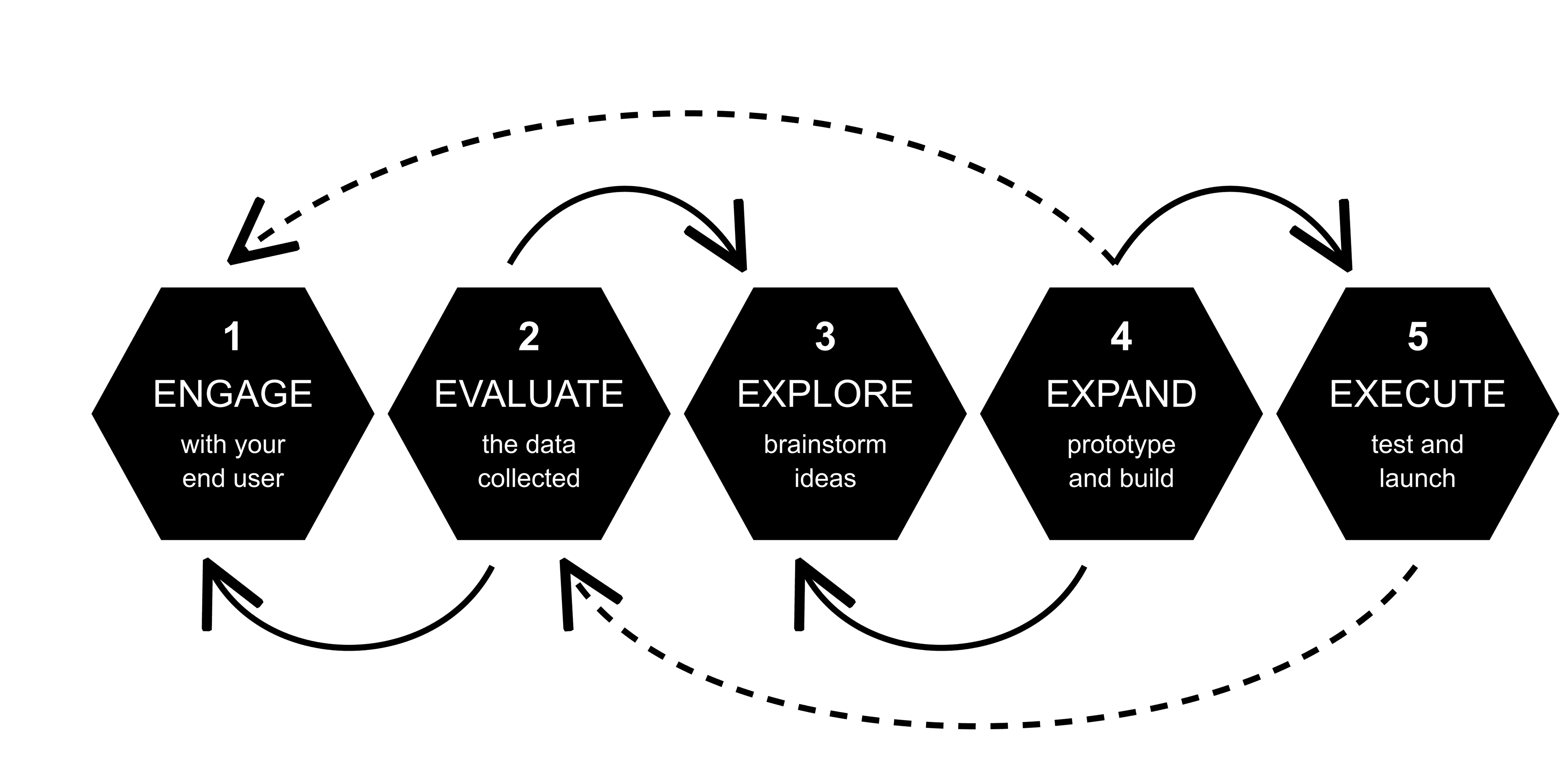
Design thinking is an iterative process used to work with complex problems and develop products, services and systems around the needs, behaviours and desires of people.
The 5E Design Thinking Framework builds the confidence to investigate what is really happening, make sense of evidence, develop alternatives, learn through prototypes and improve ideas through testing.
A scaffold, not a formula
Move forward. Circle back. Change your mind when evidence changes.
The stages overlap. New evidence may send a team back to research, reframing or ideation. That movement is not failure – it is how understanding becomes more accurate and solutions become more useful.
What the 5E Design Thinking Framework is and how it works.
Explore the five connected stages, their contribution to innovation and the framework’s application across learning, business and management.
Read about the framework →02 · Beyond the stagesWhy the 5E Design Thinking Framework exists.
Discover the philosophy of connected learning, information flow and productive tension that distinguishes the framework.
Explore the thinking behind it →03 · In practiceUnderstand the stages, flows and applications.
Move through the five stages, their questions, tools and outputs, then examine the visual language and theoretical foundations of the model.
See the framework in practice →04 · The languageWhy the terminology changed.
See why familiar design thinking labels evolved into Engage, Evaluate, Explore, Expand and Execute.
Explore the language of 5E →05 · A complementary approachPositioning 5E within design thinking.
Understand how the framework builds upon established models while making relationships, learning and information flow more visible.
See why 5E complements existing models →06 · The visual languageInnovation is not a sequence.
See how flows, feedback loops, divergence, convergence and productive tensions make the movement of understanding visible.
Explore the visual language →07 · Productive tensionsInnovation lives in the tension.
Understand how competing priorities shape judgement, learning and decision-making throughout the five stages.
Learn to navigate productive tensions →The actions at a glance
A myriad of actions, moving from left to right.
Understanding the Flow of the Framework
The five stages form an interconnected ecosystem of learning, inquiry and innovation. Each stage generates insights, evidence and opportunities, while introducing a degree of productive tension that encourages ideas to be questioned, strengthened and refined. Rather than allowing information to pass unchecked from one stage to the next, the framework deliberately filters, evaluates and synthesises what has been learned. This process helps ensure that assumptions are challenged, opportunities are validated and decisions are informed by evidence. The visual sequence illustrates how knowledge is progressively developed, tested and transformed as it flows through the framework, creating a balanced relationship between creativity, critical thinking and action.
Importantly, the framework is not intended to be followed as a rigid, one-way process. Learning generated in later stages often reveals new questions, insights or opportunities that require revisiting earlier stages. This iterative movement strengthens both understanding and outcomes, enabling teams to continuously refine their thinking as conditions change. By making the progression of knowledge visible, the framework supports collaboration, shared understanding and informed decision-making, helping individuals and organisations navigate complexity with greater confidence, adaptability and purpose.
How to Use the 5E Design Thinking Framework
The 5E Design Thinking Framework is designed to help you navigate complex challenges through a human-centred and evidence-informed process. While the stages are presented in a sequence, they should not be viewed as a rigid, linear path. Each stage builds understanding and momentum, but insights gained later in the process may prompt you to revisit earlier steps. Use the framework as a guide to structure your thinking, encourage exploration, and support informed decision-making. The value lies not simply in moving through the stages, but in the learning, reflection and refinement that occur along the way.
Move through the stages with purpose, but don't be afraid to circle back. The best solutions emerge through learning, reflection and refinement.
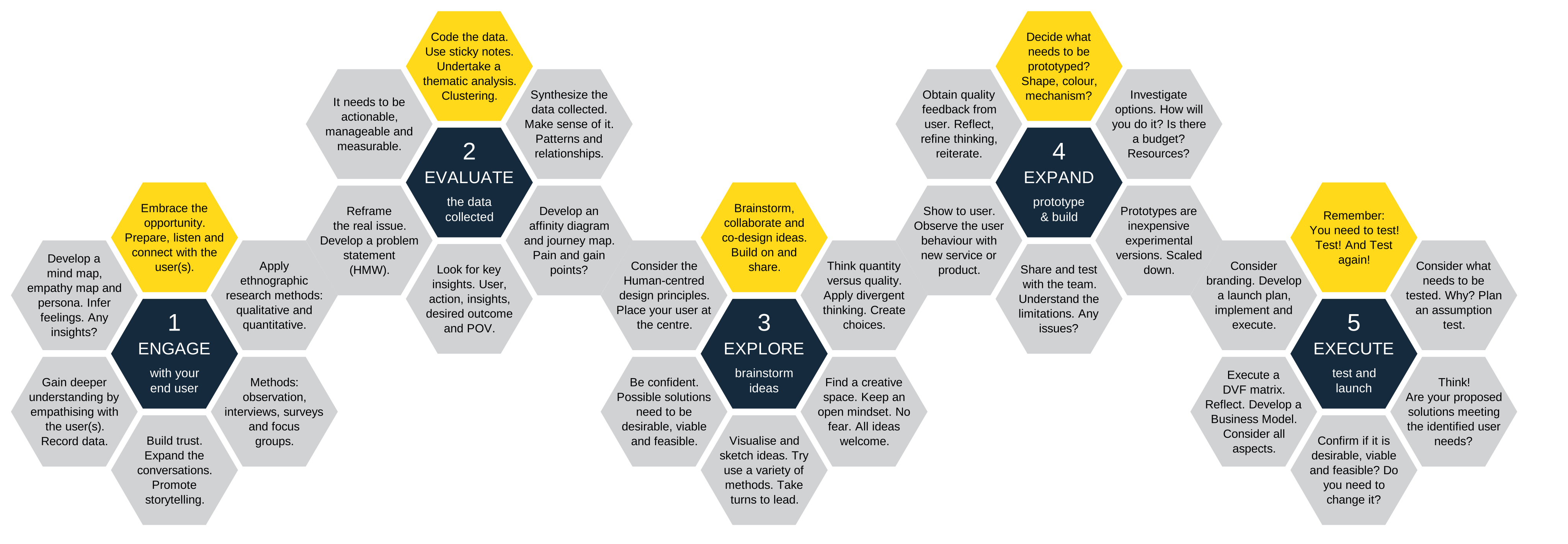
Explore the five stages
Each stage now has room to breathe.
Open a stage to explore its purpose, key activities, questions, tools, evidence and original resources.
Engage
Listen before solvingMeet people in their context. Observe, ask and listen to uncover needs, behaviours and lived experience. Seek to understand not only what people do, but why they do it. Pay attention to emotions, motivations, challenges and workarounds that shape their daily experiences. Build empathy through genuine engagement, capture meaningful insights and uncover opportunities that might otherwise remain hidden, creating a richer foundation for innovation and problem-solving.
Explore Engage →02Evaluate
Make sense of evidenceFind themes, tensions and relationships. Reframe the initial issue into a focused, actionable challenge. Look beyond surface-level symptoms to uncover underlying needs, patterns and root causes. Connect insights from different sources, identify opportunities hidden within constraints and make sense of competing perspectives. Synthesize information into a clear problem statement that guides decision-making, inspires innovation and creates a shared direction for subsequent ideation, prototyping and testing activities.
Explore Evaluate →03Explore
Open up possibilitiesThe Explore stage encourages people to move beyond obvious answers and consider multiple pathways forward.
Explore Explore →04Expand
Make ideas tangibleBuild prototypes at the right level of fidelity so people can see, experience and challenge the idea. Make concepts tangible enough to spark meaningful feedback while remaining flexible enough to evolve. Use prototypes to uncover assumptions, reveal opportunities for improvement, test user reactions and explore alternatives before committing significant time, effort or resources to full-scale development and implementation.
Explore Expand →05Execute
Test, learn and improvePut concepts in front of users. Gather evidence, reflect, refine, and prepare a thoughtful path to implementation. Embrace experimentation as an ongoing learning process, using real-world feedback to validate assumptions, uncover opportunities, and reduce uncertainty. Measure outcomes against intended goals, iterate with purpose, and make informed decisions that strengthen the solution’s value, feasibility, desirability, and long-term impact.
Explore Execute →Take it further
Use the framework in a live project.
Move into the OpenStudios Design Thinking Studio for guided projects, practical tools and editable workspaces.
Open OpenStudios ↗Return home